
Pottery, Pebbles, and Power: How the Ancient World Voted
History of Voting: Part 1 of 8
Sometime in the 480s BC, someone in Athens dumped 190 broken pieces of pottery down a well on the north slope of the Acropolis. Every one carried the same name: Themistocles, son of Neocles. When scholars studied the handwriting, they found that only about 14 people had written all of them.
Nobody knows exactly who made them or why they ended up in a well. The likeliest explanation is that Themistocles' opponents prepared ballots in advance to hand out to voters, then got rid of the leftovers. If so, it is one of the oldest physical traces of an organised effort to steer a vote. Democracy had barely begun, and people were already testing its weak points.
The vote to send someone away
The pottery shards are called ostraka, and they gave us the word "ostracism". Each year the Athenian assembly decided whether to hold one. If it agreed, citizens later gathered in the Agora and scratched onto a shard the name of the man they most wanted out of the city. Provided enough votes were cast (ancient sources usually give 6,000), the man named most often left Athens for ten years. He kept his property and citizenship. He simply had to go.
Ostracism was a safety valve against anyone growing too powerful after Athens' experience of tyranny. It also left behind the first large archive of voting material. Excavations have turned up thousands of ostraka, including some naming Pericles, the city's most famous statesman, who was never actually expelled.
The ballots also reveal a weakness: writing a name requires literacy. Plutarch tells of an illiterate farmer who asked a stranger to write "Aristides" on his shard, because he was tired of hearing Aristides called "the Just". The stranger was Aristides himself, and he obligingly wrote his own name. The story may be invented, but the problem was real. Whoever helps a voter fill in a ballot can influence it.
Pebbles, bronze and a randomising machine
Ostracism was rare. Day-to-day decisions in the assembly were made by show of hands, with officials judging the result by eye rather than counting every hand.
Courts were different. Athenian juries often numbered several hundred citizens, and their verdicts were secret. Early jurors dropped pebbles into urns. The Greek word for pebble, psephos, survives today in "psephology", the study of elections. By the 4th century BC, each juror received two bronze discs with a short axle through the middle: hollow for guilty, solid for acquittal. Holding a disc by the ends of its axle hid which one went into the counted urn and which into the discard urn. It was a ballot designed for privacy.
Athens also feared jury bribery, so it picked jurors at random with a stone allotment machine called the kleroterion. Citizens' identity tokens were slotted into rows, and coloured balls released down a tube decided which rows served that day. Nobody could know in advance who would hear a case.
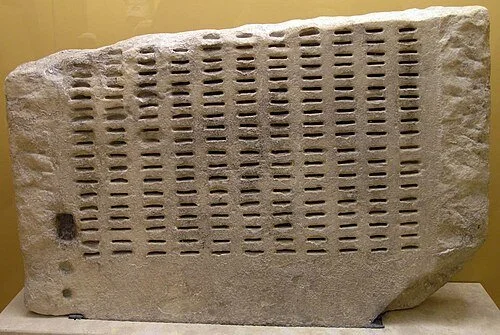
Kleroterion, Ancient Agora Museum, Athens. Photograph by Marsyas, via Wikimedia Commons. Licensed under CC BY-SA 2.5.
Shouting in Sparta
Not every Greek city trusted pottery or pebbles. According to Plutarch, Sparta elected its council of elders by acclamation. Candidates walked one by one through the assembly, while judges shut inside a nearby building, unable to see who was passing, listened for which name drew the loudest shout. It was an inventive attempt at impartial judging. It also rewarded whoever could pack the crowd.
Rome writes it down
Rome voted in groups, such as tribes or property classes, with each group's majority counting as one vote. In the assembly that elected senior magistrates, the groups were weighted so that wealthier citizens had far more say, and they voted first.
For centuries Romans voted aloud, telling an official their choice as they passed. That let powerful patrons check how their dependants voted. In 139 BC, a law proposed by the tribune Aulus Gabinius brought in written ballots for elections, and further laws over the next decade extended secret voting to trials and legislation. Voters filed across narrow raised walkways and dropped small wax-coated tablets into a basket. Conservative writers complained that the secret ballot weakened the influence of respectable men. Reformers called it freedom.
The same problems, 2,500 years later
Strip away the pottery and wax, and the ancient world was wrestling with the same questions every electorate still faces at a vote:
Secrecy: can people vote without being watched or pressured?
Integrity: can anyone produce or swap ballots in bulk?
Quorum: did enough eligible people take part for the result to stand?
Weighting: does the count correctly reflect each voter’s entitlement?
These examples show that the mechanics of a vote matter. A public vote exposes a person’s choice. A secret ballot protects it. Rules about eligibility and weighting determine whose voice counts, and by how much. Each decision shapes the process and the confidence people can place in its outcome.
At Electify, these considerations inform how we support AGMs, member elections, and union ballots. The work starts with understanding who is entitled to vote, how their votes should count, and what protections the process requires. Technology puts those rules into practice, but getting the rules right comes first.
Next in the series: how Venice used little balls and rounds of chance to elect its doge, and why we still call voting papers "ballots".
Want to see how a modern secret ballot runs? Book an Electify demo.
Sources for episode 1: Peter Sommer Travels on the Themistocles ostraka · Mabel Lang, Ostraka (Athenian Agora XXV, 1990) · Politics in the Ancient World, ch. 3, Cambridge University Press · Plutarch, Aristides 7 and Lycurgus 26 · Cicero, On the Laws 3.33–39 (Roman ballot laws).
